
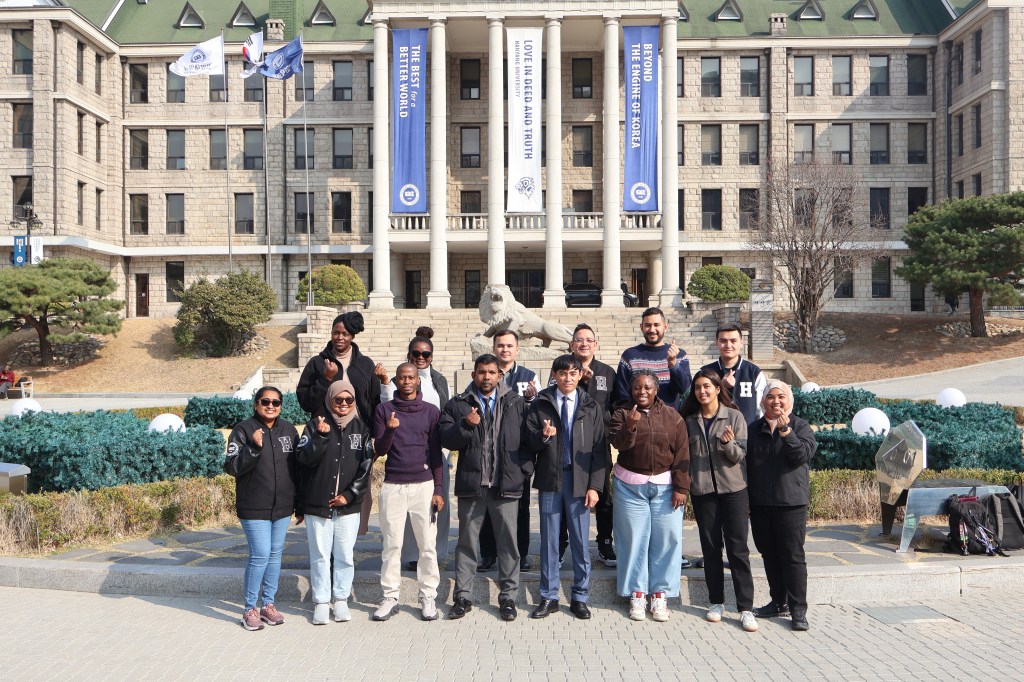
As part of the ongoing 2026 BACUDA Scholarship Programme, the World Customs Organization (WCO) delivered a series of specialized sessions from 16 to 20 March 2026 at Hanyang University, Republic of Korea. These sessions form a key component of the Programme, bridging academic learning with practical applications in Customs data analytics.
Building on the Programme’s structured curriculum, the WCO sessions focused on enhancing participants’ technical and operational understanding of data analytics and artificial intelligence (AI) in the Customs context. The sessions introduced core concepts of the BACUDA Project, including the practical use of analytics in risk management and decision-making.
Participants were guided through the application of the WCO’s AI/ML Readiness Self-Assessment Tool, enabling them to evaluate their administrations’ current level of maturity and identify priority areas for development. This exercise supports Members in designing actionable roadmaps for the adoption of data analytics and AI.
A central element of the sessions was the hands-on application of BACUDA algorithms. Participants explored the LITE-DATE model for detecting anomalies and potential fraud patterns, as well as the AI-HS model, which leverages machine learning techniques to support the classification of goods under the Harmonized System. The training included practical exercises using synthetic datasets, data preprocessing techniques, and model preparation workflows.
In addition, the sessions introduced emerging technologies such as generative AI, fostering discussions on their potential applications in Customs operations, including automation, classification support, and enhanced analytical capabilities.
The Programme also provided a platform for experience sharing among Members. Case studies from Maldives Customs and Cambodia Customs highlighted practical implementation of data analytics in operational environments, offering insights into both challenges and success factors.
As part of the learning process, participants presented their capstone project concepts and received expert feedback, further strengthening the link between theoretical knowledge and real-world application.
The sessions concluded with an experience-sharing segment led by WCO experts, emphasizing post-scholarship impact and the importance of the WCO Expert Accreditation Programme in building global expertise in Customs data analytics.
The WCO remains committed to supporting its Members through initiatives such as the BACUDA Project, fostering innovation, strengthening analytical capacity, and advancing the transition towards data-driven Customs administrations.
 WCO BACUDA Project