
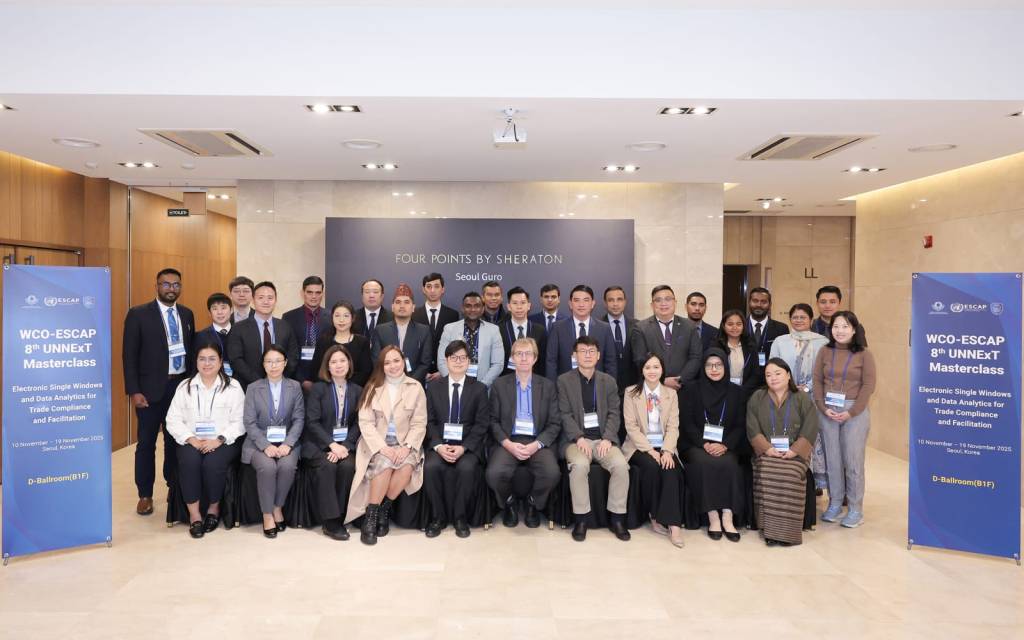
From 10 to 19 November 2025, the World Customs Organization (WCO), in collaboration with the United Nations Economic and Social Commission for Asia and the Pacific (UN ESCAP), successfully conducted the 8th UNNExT Masterclass on Electronic Single Windows and Data Analytics for Trade Compliance and Facilitation in Seoul, Republic of Korea. Supported by the Customs Cooperation Fund of Korea (CCF-Korea), the Masterclass brought together 22 participants from Customs administrations and economic and trade ministries across the Asia–Pacific region to explore practical approaches to advancing paperless trade, implementing Single Window systems, and strengthening data-driven decision-making.
The programme opened with high-level remarks from representatives of the WCO, UN ESCAP, ROCB A/P, RTC Korea, and the Korea Customs Service (KCS). Participants were introduced to ESCAP’s trade facilitation programmes and engaged in Business Process Analysis (BPA) exercises, enabling them to identify bottlenecks in cross-border trade procedures and design more efficient and harmonized processes.
As part of the Masterclass, the WCO delivered a dedicated Data Analytics session through the BACUDA Project. This session covered the fundamentals and organizational value of data analytics, demonstrations of BACUDA algorithms, practical exercises on data preparation and data quality management, and the use of AI-based HS classification tools. Participants gained hands-on experience with the AI-HS Recommendation System, explored NLP-based analytics pipelines, and examined the application of AI tools for identifying and expediting environmental goods. These activities deepened their understanding of how data and AI technologies can drive transformative improvements across Customs operations.
Throughout the Masterclass, participants benefited from a wide range of expert-led thematic sessions, including innovative technologies for Single Window implementation, interoperability solutions, AI ethics and governance, image-based classification models, and global case studies on Customs digital transformation. They also visited RTC Korea and the Customs Learning Center, where they learned about the Korea Customs Service’s practical experiences with big data and AI-driven administrative modernization.
The programme concluded with group discussions, exercises, and final presentations in which participants proposed data-driven and technology-enabled policy ideas tailored to their national contexts. The WCO expressed its appreciation to CCF-Korea for its support and to all participants for their active engagement. The WCO remains committed to supporting Members in accelerating digital transformation and strengthening their capacity to leverage technology for trade facilitation and compliance.
 WCO BACUDA Project